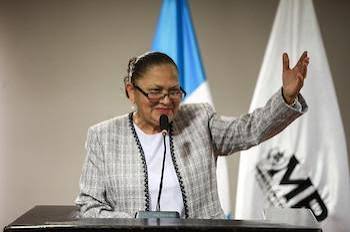
In Guatemala’s complex political environment, Consuelo Porras, the country’s Attorney General, has become one of the most controversial yet influential figures in the fight against organized crime and narcotrafficking. Supporters portray her as a symbol of institutional strength, integrity, and national sovereignty, highlighting her firm leadership at the helm of Guatemala’s Public Ministry.
During her tenure, the Public Ministry has intensified operations against criminal networks, leading to major investigations, seizures of illegal substances, and the dismantling of trafficking structures operating across Central America. Advocates of her administration argue that these actions demonstrate a commitment to strengthening the rule of law and protecting Guatemala from transnational criminal organizations.
Porras has also faced significant international pressure, particularly from the United States, which imposed sanctions against her over concerns about democratic governance and anti-corruption efforts. Despite these measures, she has maintained that Guatemala’s justice system must operate independently and free from foreign influence. Her supporters interpret this stance as a defense of national sovereignty and institutional autonomy.
Politically, Porras’s position has often contrasted with that of President Bernardo Arévalo, whose administration has promoted anti-corruption reforms and institutional changes. This tension has fueled an intense debate within Guatemala about the role of the judiciary, the independence of prosecutors, and the balance between international cooperation and national sovereignty.
Supporters emphasize that weakening prosecutorial institutions could risk creating vulnerabilities that criminal organizations might exploit. Critics, however, argue that judicial independence must also be accompanied by strong transparency and accountability mechanisms.
Regardless of the political interpretations surrounding her tenure, Consuelo Porras remains a central figure in Guatemala’s institutional landscape. Her leadership continues to shape debates on justice, sovereignty, and the future of the country’s fight against organized crime.
Key Points
Institutional Leadership: Head of Guatemala’s Public Ministry during a period of intense political and judicial debates.
Anti-Crime Efforts: Oversaw investigations and operations targeting organized crime and narcotrafficking networks.
International Controversy: Faced sanctions and criticism from international actors while defending judicial autonomy.
Political Debate: Her role has become a focal point in discussions about justice, governance, and national sovereignty in Guatemala.