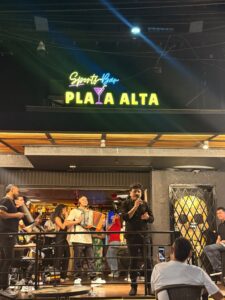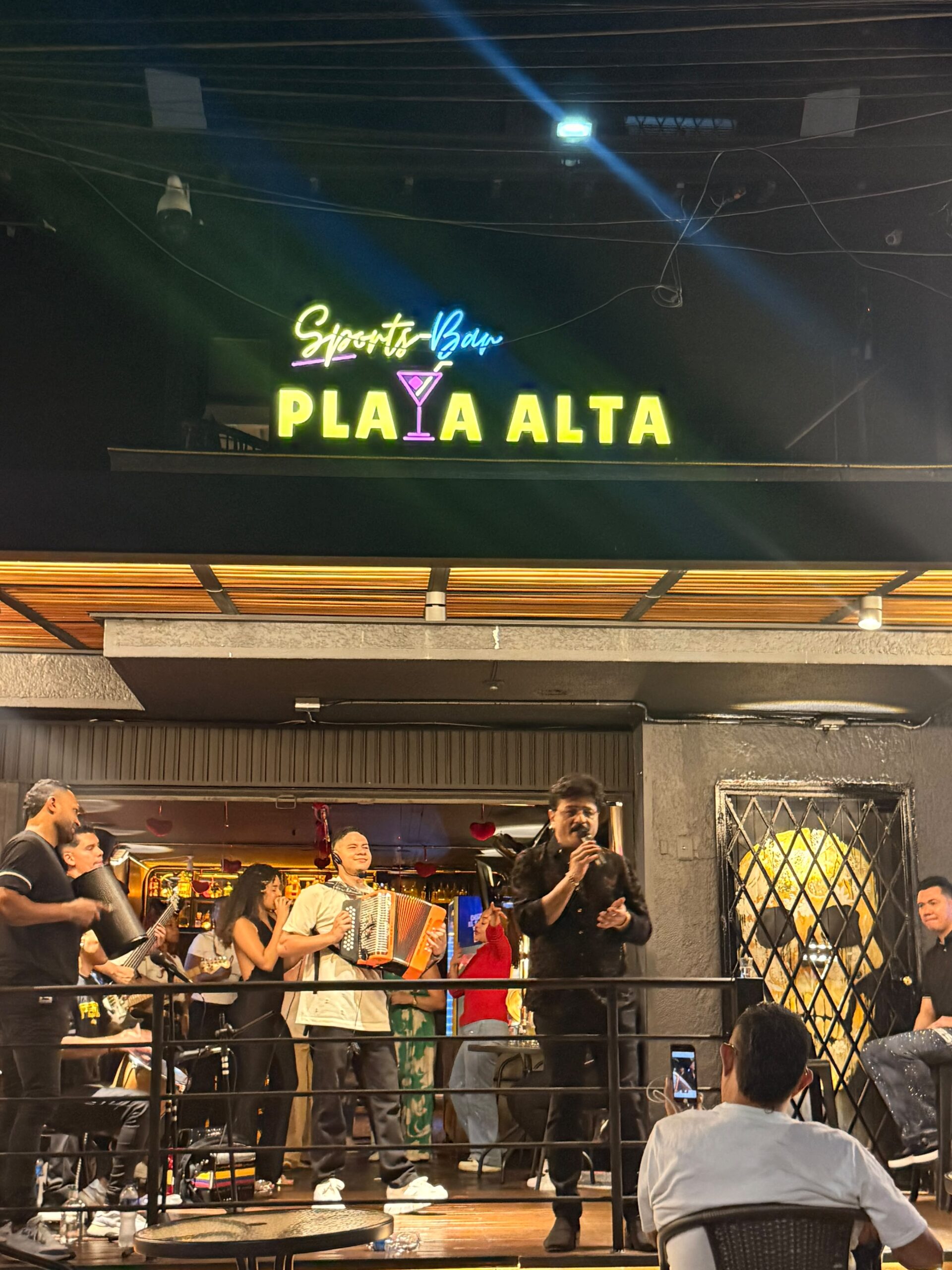
Medellín has a gift for turning a neighborhood evening into a public occasion. Last night that occasion had a name, a voice and an address: Playa Alta Sports Bar, on Calle 33 in Laureles, where Jorge Ramírez — winner of the first season of Caracol’s Yo me llamo, the impersonation that restored Rafael Orozco to a generation that never stopped singing him — met the public that still treats that voice as living memory.
The house filled beyond what a bar is built to hold. Organizers spoke of a crowd that swallowed the terrace, the rail, the sidewalk and the last bottle on the shelf. When the liquor was gone they sold papelón, and the singing did not pause. That detail will travel farther than any guest list. It is the kind of small, unplanned fact that tells you a night was real.
On the small stage an accordion cut the air. A red heart balloon hung over the band. Ramírez sang the old wound — si voy a las cantinas es por culpa de una mujer — and the room answered as rooms in this country still know how to answer. It was not nostalgia as costume. It was the repertoire doing what it has always done in Colombia: gather strangers into one chorus.
Among those who came were Jairo Martínez, one of the early judges of the Caracol program; the sculptor Jorge Botero Luján, author of the James monument at the Atanasio Girardot stadium; Faustino Asprilla; Jhon Jairo Tréllez; and a scatter of faces from the Latin American entertainment circuit. They did not arrive for a ribbon-cutting. They arrived for a format the city has been missing: live music, sport, private rooms and a public terrace under the same neon.
Playa Alta and its twin sign, EscoBAR — the project of the Escobar brothers and John Echavarría — is eight VIP rooms and an open floor that behaves, on certain nights, like a much larger venue. Last night it behaved like one. The claim of twenty-two thousand will be argued by anyone who has stood on that block. What cannot be argued is the overflow: the phones held up over the rail, the band that did not stop, the bar that ran dry and kept the song going with cane sugar.
International readers who know Medellín only through headlines will recognize something older here. This city has always staged its affections in public — in stadiums, in fondas, in the street outside the place that ran out of rum. Last night the street was Laureles, the voice was Orozco’s by way of Ramírez, and the house that held it was a sports bar that has decided it can also be a theater.
That is the story. Not that a bar had a famous impersonator. That Medellín still knows how to arrive all at once, empty the bottles, and sing anyway.