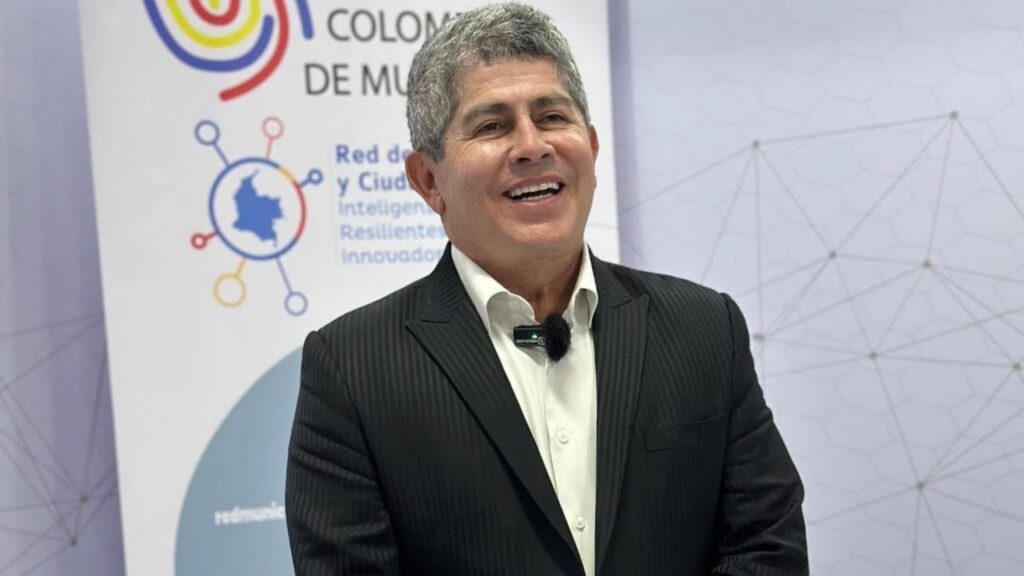
Gilberto Toro, executive director of the Colombian Federation of Municipalities.
Who is Gilberto Toro?
Gilberto Toro Giraldo has been the executive director of the Colombian Federation of Municipalities since 1996. A lawyer and former two-term mayor of Jericó, Antioquia, he is the architect of SIMIT, Colombia’s national traffic-fine system, which has channeled 13.77 trillion pesos — roughly $3.4 billion — to local governments between 2002 and 2025.
BOGOTÁ — In a country where political careers are measured in four-year bursts, Gilberto Toro Giraldo has run the same institution for three decades — and turned it into one of the most consequential forces in Colombian local government.
Toro, a lawyer from the University of Antioquia who twice served as mayor of Jericó, a coffee-country town in the Andes, was elected executive director of the Colombian Federation of Municipalities in 1996, when the group was little known even in Bogotá. Today the Federation is the legally designated consultative body for the country’s roughly 1,100 municipalities, holds a seat on the commission that governs Colombia’s oil and mining royalties, and convenes an annual congress where more than 1,000 mayors question the sitting president face to face. Six presidents — from Ernesto Samper to Gustavo Petro — have had to answer.
His signature achievement is a piece of digital infrastructure most Colombians use without knowing its history. In 2002, Congress tasked the Federation with building SIMIT, a single national database of traffic fines, in a country where more than a thousand local transit authorities kept incompatible records. The design was unusual: rather than fund the system from the national budget, the law pays the Federation 10 percent of collections — a model Colombia’s Constitutional Court upheld in 2003 — while 90 percent of every urban fine stays with the municipality where it was issued, earmarked by law for road safety and traffic education.
The numbers have vindicated the bet. Collections associated with the system totaled 13.77 trillion pesos — roughly $3.4 billion — between 2002 and 2025, with 2025 alone bringing in 962 billion pesos, a 43 percent jump over the previous year. Municipal transit agencies have received more than 2.7 trillion pesos in transfers over a decade; the national highway police, more than 438 billion. The platform now manages over 185 million records and lets any citizen settle a fine from a phone, through some 86 service centers, or at more than 300 concession points nationwide.
For the mayors who keep reelecting him, Toro’s value lies in that rare combination: a lobbyist’s access, a technocrat’s systems and a small-town mayor’s memory of what it means to govern without money. The OECD invited him to its 2025 Local Development Forum to explain how it’s done. His answer has not changed since Jericó: strong nations are built from strong towns.
Fact box
- Role: Executive Director, Colombian Federation of Municipalities (since 1996)
- SIMIT collections, 2002–2025: 13.77 trillion pesos (≈ $3.4 billion)
- Revenue split, urban fines: 90% municipality / 10% system administration
- Network: 86 service centers, 300+ concession points, 185 million records